The Legacies of Great Wars -
Gender
and the war: Mother’s Day versus flappers


My favorite was what the French authorities proclaimed, "Mother's Day as a new holiday designed to encourage childbearing and thus replace the millions lost in the war" (Strayer p. 988). I never knew that this was the case. It is a very interesting way to look at Mother's day. I am little thrown off.. I am not sure how to respond to this. Encouraging women to have kids and as result you get a holiday? I don't see the incentive. I have 4 children and I love them to death. I had kids because I wanted too not because I get a holiday. To be honest, it is almost like being jipped - only once a year - so what is the history of Father's day? Luckily, the US had a different stand point on Mother's day.
So I did my little digging around on the internet and this is what I came up with for Mother's and Father's Day for the U.S. from the History. Below are excerpts I copied and pasted into this blog - check out the link to read more about the history of Mother's and Father's day (link: http://www.history.com/topics/holidays/fathers-day).
Mother's Day -
 |
| [Mother’s Day did not become a commercial holiday until 1908, when–inspired by Jarvis’s daughter Anna, who wanted to honor her own mother by making Mother’s Day a national holiday–the John Wanamaker department store in Philadelphia sponsored a service dedicated to mothers in its auditorium. Thanks in large part to this association with retailers, who saw great potential for profit in the holiday, Mother’s Day caught on right away. In 1909, 45 states observed the day, and in 1914, President Woodrow Wilson approved a resolution that made the second Sunday in May a holiday in honor of “that tender, gentle army, the mothers of America.”] |
Father's Day -
 |
| [Sonora Smart Dodd, one of six children raised by a widower, tried to establish an official equivalent to Mother’s Day for male parents. She went to local churches, the YMCA, shopkeepers and government officials to drum up support for her idea, and she was successful: Washington State celebrated the nation’s first statewide Father’s Day on July 19, 1910. Slowly, the holiday spread. In 1916, President Wilson honored the day by using telegraph signals to unfurl a flag in Spokane when he pressed a button in Washington, D.C. In 1924, President Calvin Coolidge urged state governments to observe Father’s Day. However, many men continued to disdain the day. As one historian writes, they “scoffed at the holiday’s sentimental attempts to domesticate manliness with flowers and gift-giving, or they derided the proliferation of such holidays as a commercial gimmick to sell more products–often paid for by the father himself.”] |
Flappers
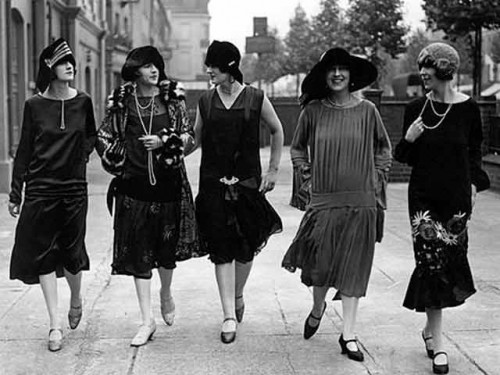
Lastly, our Flappers - we gotta love them. Our rebel ladies that defied being of the norm. "The young middle-class women, sometimes known as "flappers," began to flout convention by appearing at nightclubs, smoking, dancing, drinking hard liquor, cutting their hair short wearing revealing clothing, and generally expressing a more open sexuality" (Strayer p. 988). It pretty much sounds like college to me. Our perspective has definitely changed since then. I don't think there is nothing wrong with having a little fun. We all need it every now and then. I guess during this time is was clear that women were making a statement now. We have definitely gone a long way since then.


No comments:
Post a Comment